Summary of George River Pacific Salmon Smolt Study
Funded By:
Donlin Gold LLC
2525 C St Suite 450
Anchorage, AK 99503
Study Completed By:
The Native Village of Napaimute
P.O Box 107
Aniak, AK 99557
www.napaimute.org
Owl Ridge Natural Resource
Consultants, Inc.
4060 B Street, Suite 200
Anchorage, AK 99503
What was studied?
A 2-year proof-of-concept study to understand salmon smolt outmigration on the George River.
Sampling Period
May 8 through June 18, 2025
Goal
Estimate juvenile salmon abundance and test monitoring methods.
Methodology
Sampling sites: Located upstream of the ADF&G salmon weir based on existing infrastructure and known salmon runs.
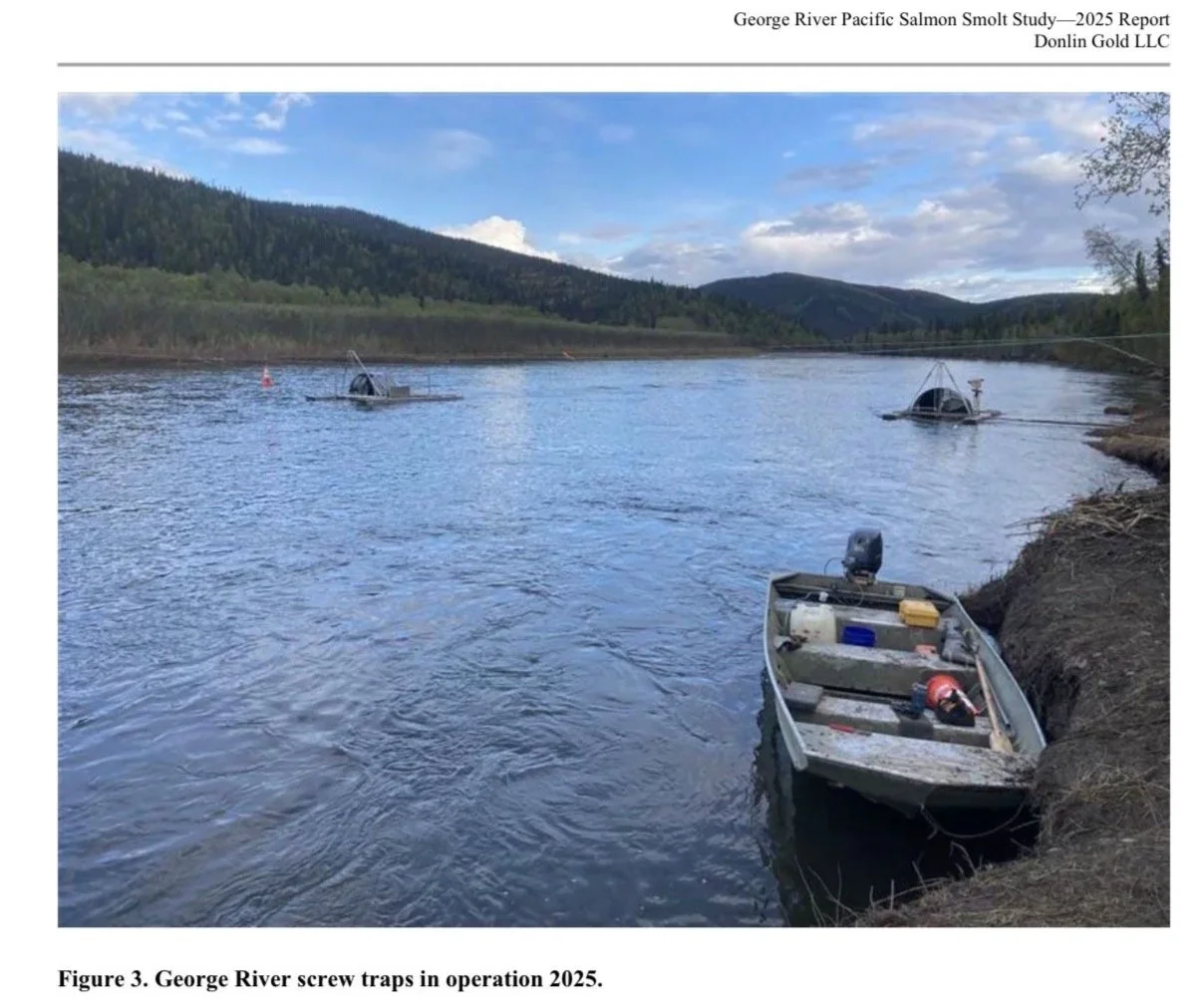
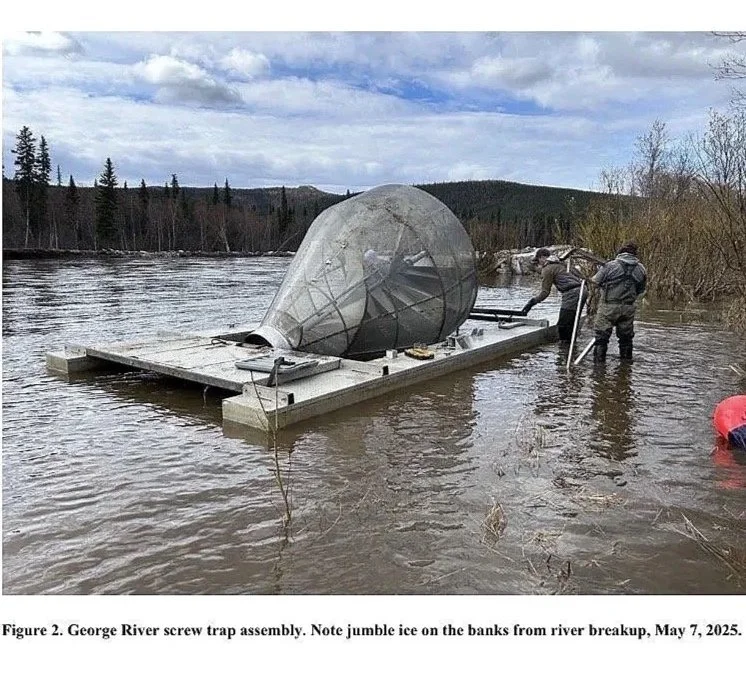
Fish capture: Two 8-foot rotary screw traps (riverbank + mid-river) captured out-migrating juvenile salmon.
Fish handling: Fish identified by species, measured for length and weight, and temporarily held in aerated containers.
Release method: Fished released upstream at night to match natural migration behavior.
Mark-recapture: used to estimate total smolt abundance.
Environmental data: water temperature, water level, dissolved oxygen, and conductivity recorded using standardized methods.
Data analysis: Population estimates calculated using time-stratified, Bayesian mark-recapture models.
Model adjustments: Models accounted for missed sampling days and migration outside trap deployment dates.
Results
41 days of sampling
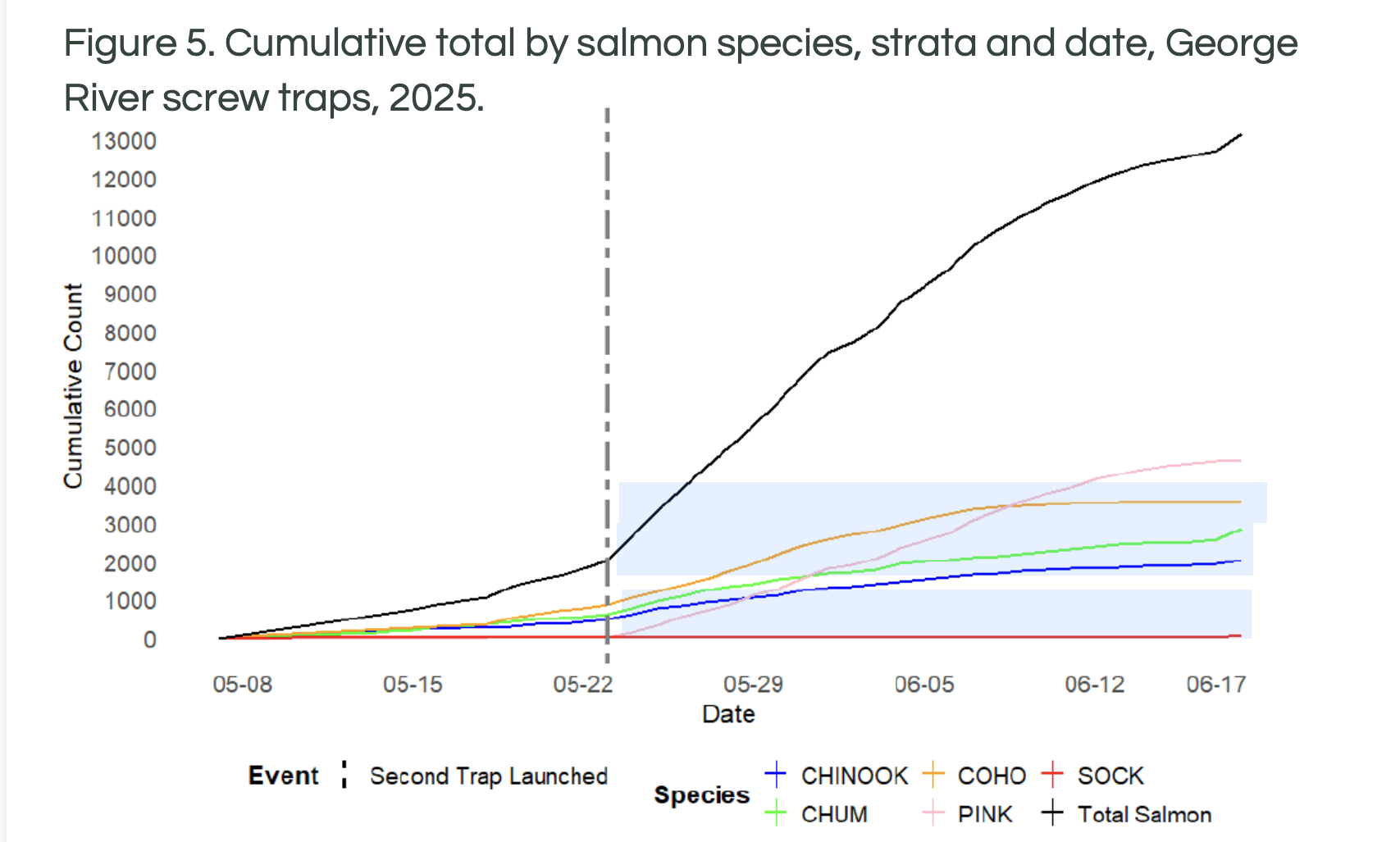
13,281 fish captured
Species documented
-Chinook
-Chum
-Coho (most abundant)
-Pink (most abundant)
-Sockeye (least abundant)
Abundance estimates
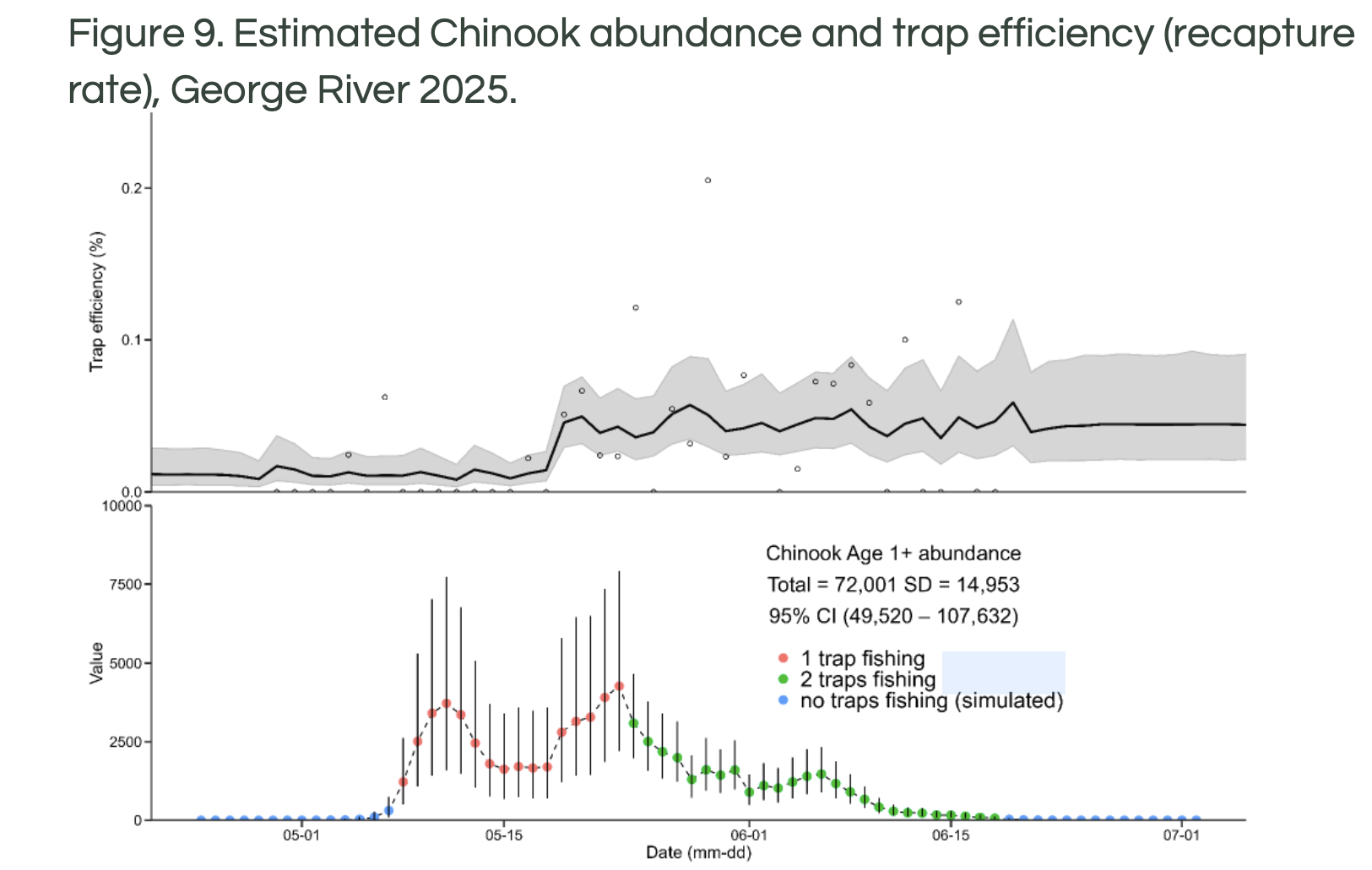
-Chinook (age 1+): ~49,000-108,00
-Chum (young-of-year): ~185,000-495,000
-Coho (age 1+): ~67,000-108,000
Trap performance
-Chinook & Coho: Recapture rates high enough for reliable population estimates
-Chum: Lower recapture rates led to higher uncertainty
Migration timing
-Chinook & chum peaked in late May
-Coho & pink peaked in early June
-Chum migration likely extended beyond sampling period
Key Takeaways
Smolt monitoring on the George River is feasible and effective.
Juvenile salmon production appears lower than comparable rivers.
Multiple years of data are needed to better understand trends and drivers.
References
Alaska Salmon Research Task Force Report. 7/17/2024. Numerous agencies. https://www.fisheries.noaa.gov/s3//2024-07/alaska-salmon-research-task-force-0717.pdf
Boersma, J.K., K.C. Harper and L.G. Coggins Jr,. 2019. An assessment of Kwethluk River Chinook salmon freshwater production.
Project Final Product, submitted to the Arctic-Yukon-Kuskokwim Sustainable Salmon Initiative.
Bonner, Simon J., and Carl J. Schwarz. "Smoothing population size estimates for time-stratified mark–recapture experiments using
Bayesian P-splines. " Biometrics 67, no. 4 (2011): 1498-1507.
Burril, Sean E., Cristian E. Zimmerman, James E. Finn, and Daniel Gillikin.
"Abundance, timing of migration, and egg-to-smolt survival of juvenile chum salmon, Kwethluk River, Alaska. " Open File